Spatial Audio Explained: Why It Sounds So Real and Why It Matters

In the world of entertainment these days, whether you’re listening to music, watching a movie or binge-watching the latest series, you can’t do much without tripping over the term “spatial audio”. It’ll be there lurking on your phone, or it’ll get you in a cinema trailer, even buried deep inside a settings sub-menu on your TV that you’ve probably never done anything with.
For a lot of consumers, it would be easy to write it off as the current buzzword. But when spatial audio is done right, you don’t just hear a real difference, you feel it. It’s a cliché, but when you experience it properly, going back to ordinary sound feels a lot like switching from high-res streaming to VHS-quality video.
So… what is spatial audio all about?
At its core, spatial audio is about placing sound in precise locations in space, not from a speaker.
Traditional audio formats like mono and stereo focus on where speakers are. Spatial audio focuses on where sounds exist around you.
Instead of sound coming from left and right, spatial audio allows sound to move around you, come from above or behind or stay fixed in space even when you move – mirroring reality.
Your brain doesn’t just hear sound; it’s always processing and calculating where it’s coming from. Spatial audio taps into that natural ability, recreating how we hear in the real world.
When it works well, your brain stops analysing and starts believing.
Stereo vs Surround vs Spatial Audio: What’s the Difference?
This is where things often get confusing.
Stereo
Stereo audio uses two channels: Left and right.
It’s brilliant for music, but everything happens on a horizontal line in front of you.
Increasingly, artists are creating in immersive formats, and you won’t experience these albums as the artist intended from a stereo downmix.
Surround Sound
Surround sound adds more speakers – typically 5.1 or 7.1 – placing sound around a room.
It improves immersion, but it’s still speaker-based, not listener-based. It builds a “sweet spot” where the best experience is delivered. You need to stay anchored there to experience it.
Spatial Audio
Spatial audio flips the logic. It’s not about using the surround sound speaker closest to where the sound should come from, it’s about rendering without those limitations, building a world of audio with the listener at the centre.
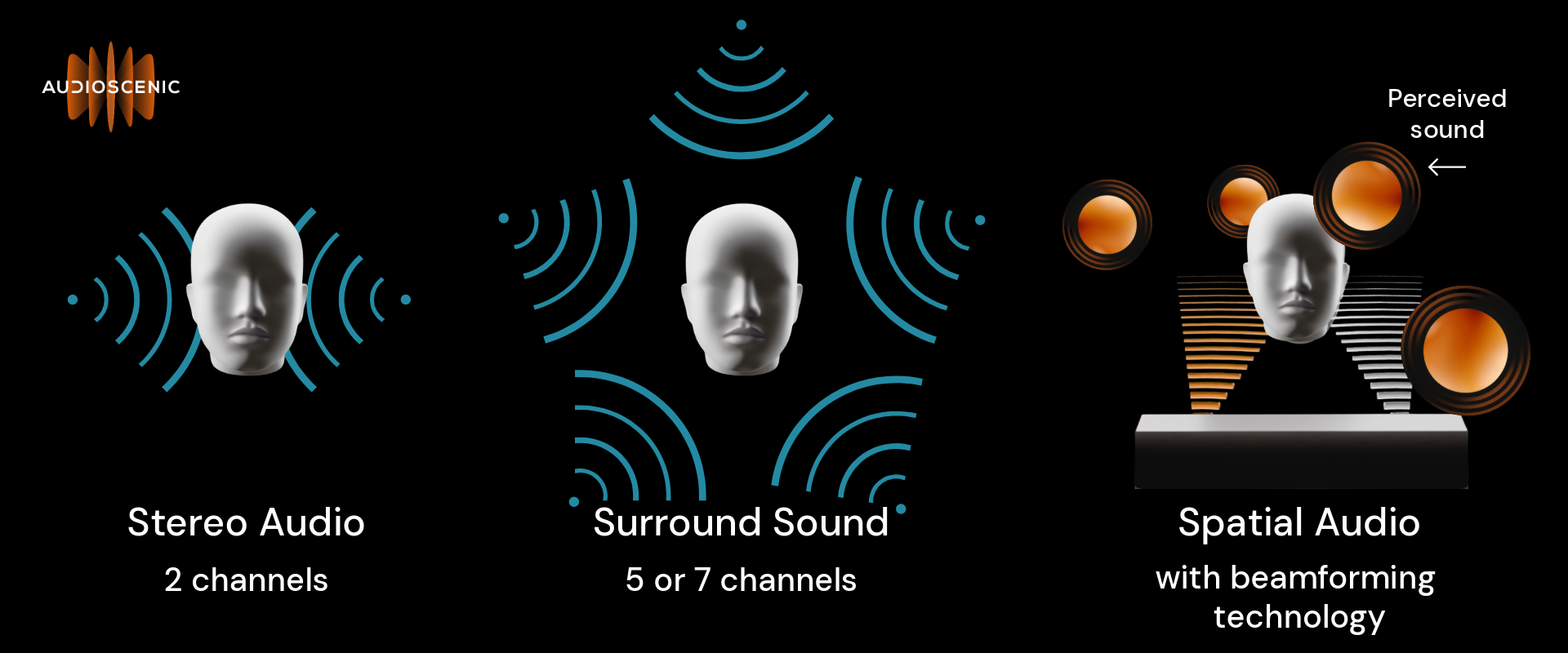
That’s a big difference.
Spatial audio systems calculate how sound should reach your ears, accounting for: direction, distance, movement, even subtle timing differences between ears.
However, the Achilles’ heel for many systems is the listener. Where listeners move, the sweet spot really needs to follow, so the rich audio world that’s been built feels truly natural, without the listener having to play statues. That’s where Audioscenic’s unique head-tracked spatial audio takes it to the next level.
Why Spatial Audio Sounds So Real
Your ears are finely tuned instruments, and your brain is one of the most powerful processing engines in the world. It uses tiny clues to interpret sound. Which ear hears it first, and how long the gap is between that and the second ear picking it up. How sound reflects off of walls, how it changes when you move your head…
Spatial audio recreates these cues digitally. That’s why, when it’s done right, the footsteps feel like they’re actually behind you, music feels richer and more powerful and movie dialogue is present, not projected.
Your brain recognises the pattern and says: “Yes. That’s real.”
That’s the magic moment. When the technology’s so good, it disappears.
What Spatial Audio Is NOT
It’s not a gimmick
The term is being over-used, and big promises are being made from technology that doesn’t truly deliver. But the concept itself is grounded in real psychoacoustics.
It’s not just “more speakers”
You don’t need a room full of hardware for spatial audio to work. Audioscenic’s unique technology can deliver a true spatial experience with as few as two speakers.
It’s not just for audiophiles
Spatial audio is intuitive. You don’t need trained ears, just human ones.
If it feels complicated, that’s usually a sign the technology hasn’t been made accessible… yet. That’s something the team at Audioscenic is working to deliver.
Why Spatial Audio Is Suddenly Everywhere
Spatial audio isn’t new. Like most emerging technologies, it takes a few iterations before both the tech and the world are ready. But everything has aligned.
Three big shifts are happening at once:
1. Content Is There
Movies, games, and music are already being mixed spatially. Creators are ahead of playback.
2. Processing Power Has Caught Up
Modern devices can now handle real-time spatial rendering without breaking a sweat.
3. Expectations Have Changed
Listeners are starting to experience real spatial content, and expectations have shifted. The demand is there for immersive, personal and adaptive audio – not fixed and flat sound.
Why Playback is the Missing Piece with Spatial Audio
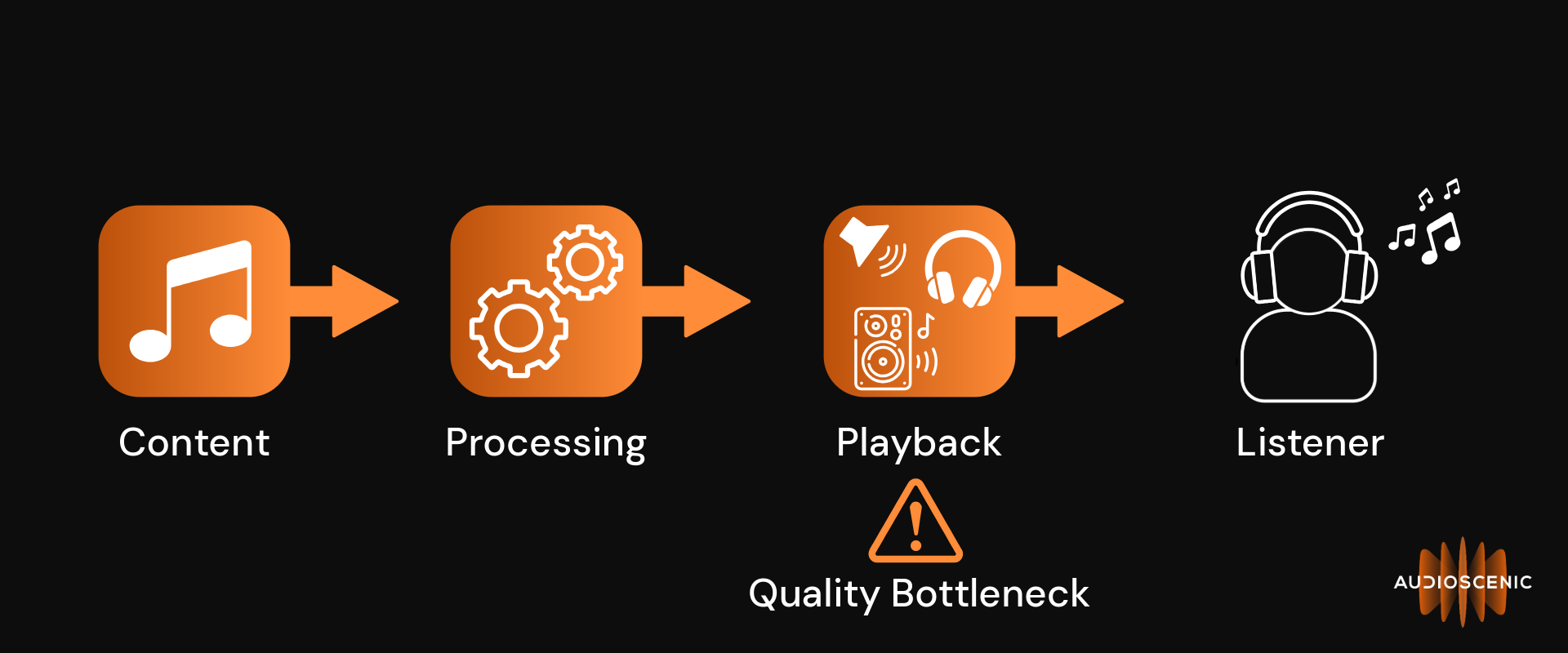
The uncomfortable truth is that most people likely haven’t ever heard spatial audio properly, certainly not to its full potential.
Sound can be mixed in 3D space, but when it’s played back through systems that can’t reproduce it accurately, the effect collapses and distorts. That’s why spatial audio’s next leap isn’t about formats, it’s about how sound reaches your ears.
When playback adapts to you, the value of spatial audio finally clicks into place. And once it does, it’s hard to un-hear. And it's even harder to go back.
The rise of spatial audio isn’t about specs, or buzzwords. It matters because it levels up your experience of entertainment, making it more emotional and more enjoyable. It closes the gap between watching and being there.
We fully expect that, just like HD video quietly replaced SD, spatial audio won’t announce itself loudly, it’ll simply become expected.
If you want to join the revolution, you can sign up to our Newsletter for exciting updates.


